Find a Resource
The Mentor-Connect resource collection provides multiple formats specific to preparing competitive grant proposals for submission to the National Science Foundation Advanced Technological Education (NSF ATE) Program. Included are instructions and helpful hints for those who are submitting proposals, navigating the NSF funding process, and implementing funded projects. While these resources have been created and curated to be specifically helpful for the NSF ATE Program, the guidance is applicable to other NSF funding programs.
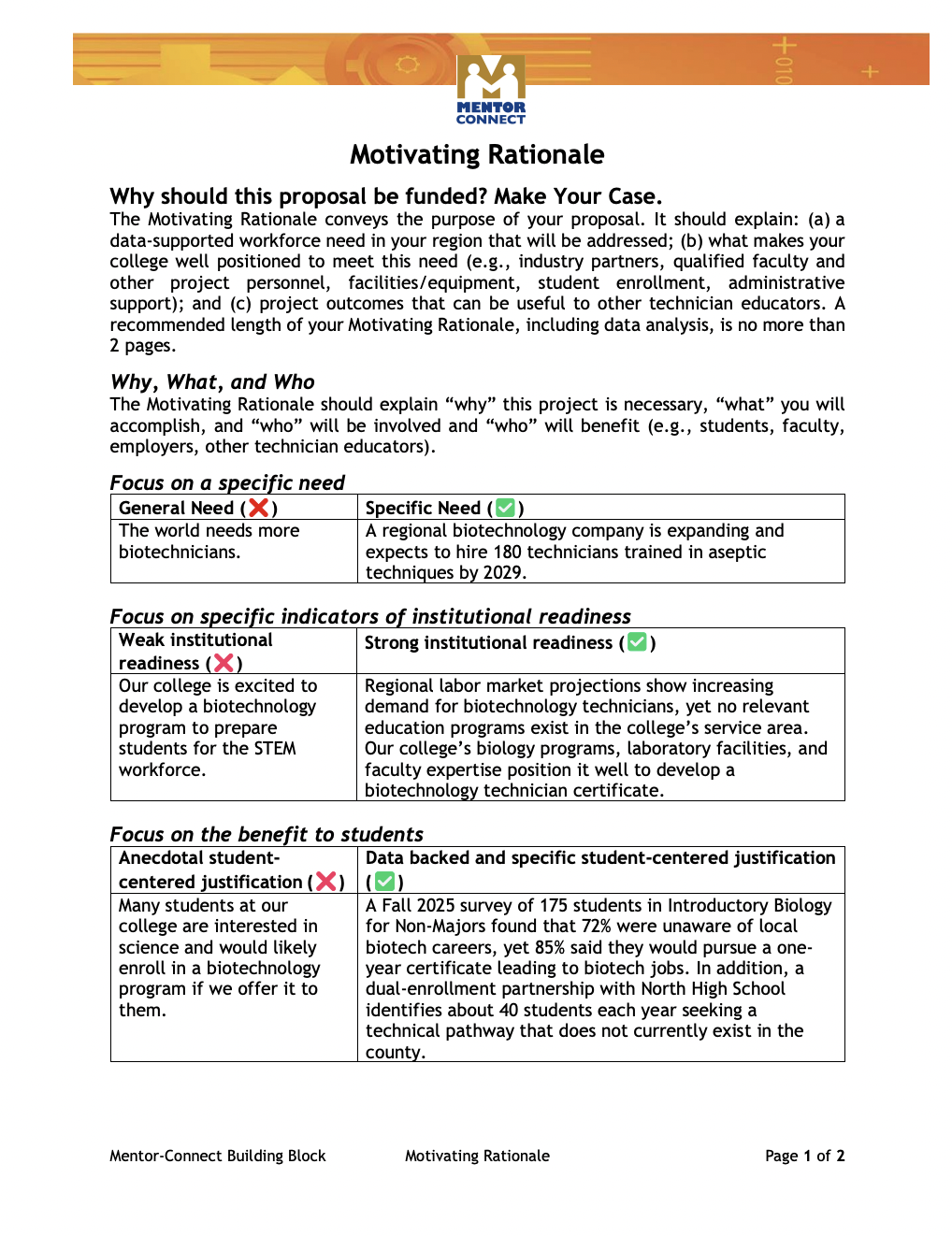
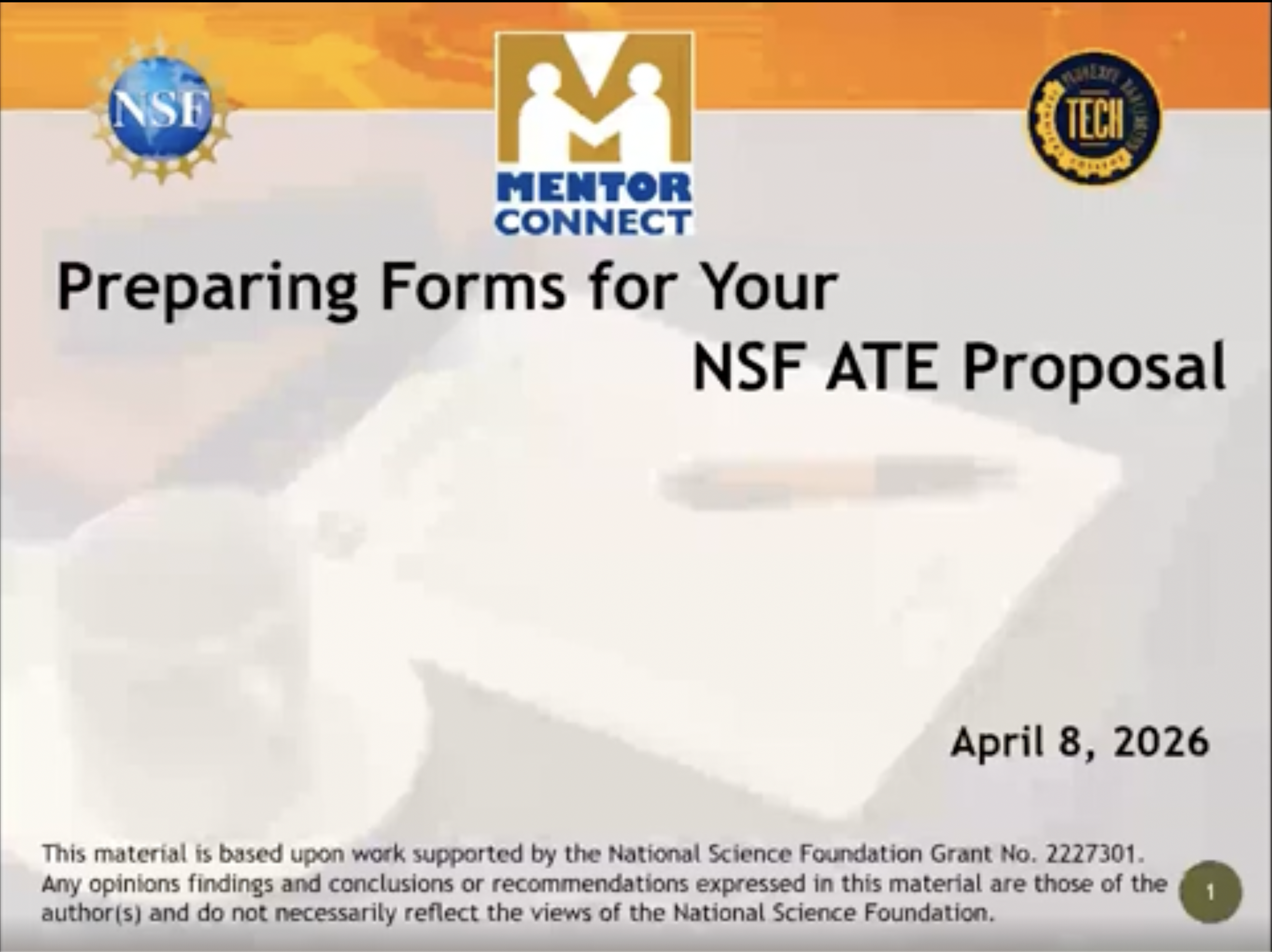
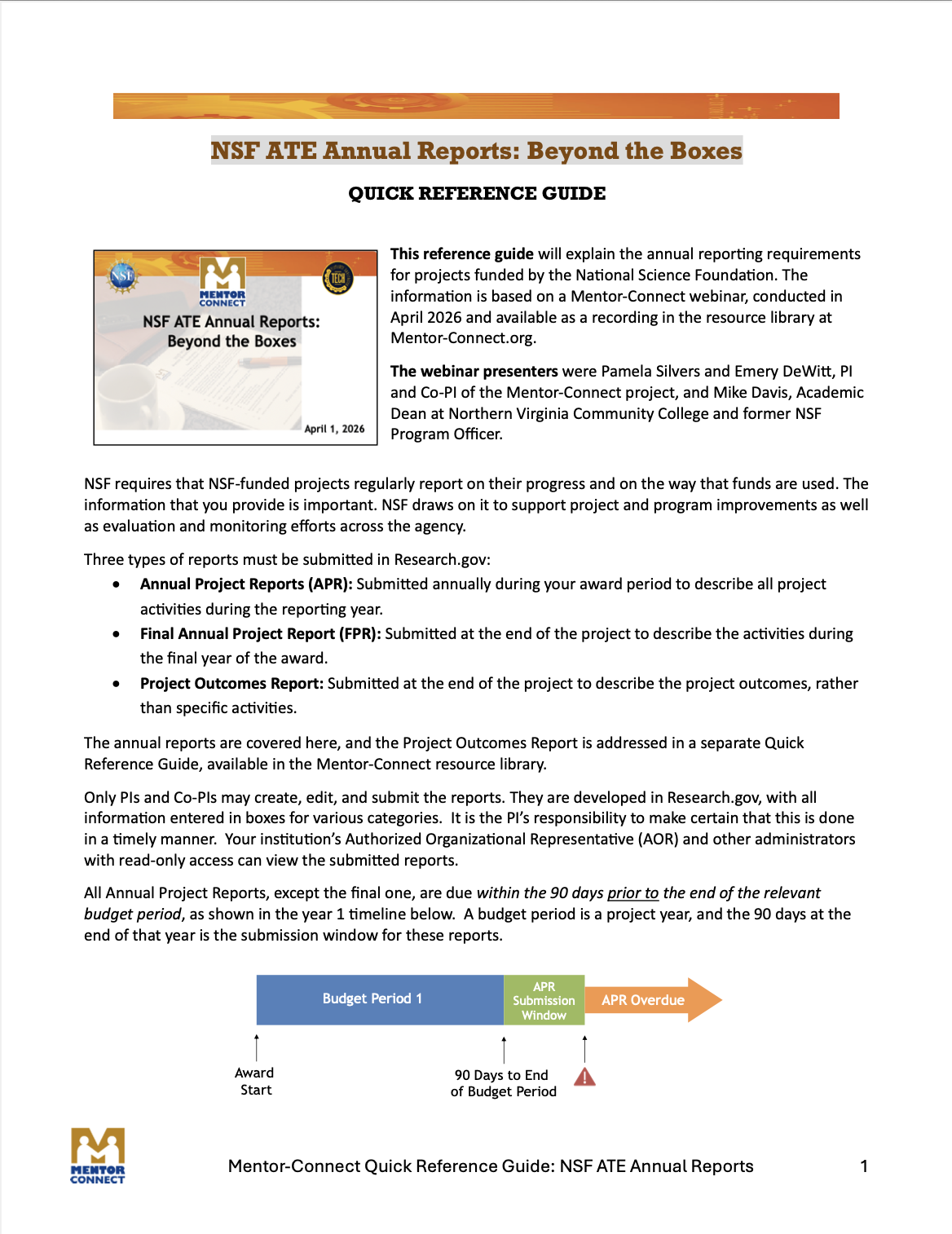
Mentor-Connect’s collection contains print materials, webinars, and links to other helpful sites. Users will find the most current grant proposal guides and updates from the NSF, webinars conducted by Mentor-Connect for all aspects of grant writing, sample documents provided by former and current grantees, and a large supply of informational documents.
Featured Resources
NSF ATE Glossary
View our glossary intended to inform potential grantees about the various acronyms and terminology used around NSF’s work and projects.
NSF ATE Program Solicitation
View the solicitation to find helpful information, such as program requirements, proposal processing and review procedures, award administration, agency contacts, and more.
NSF Proposal and Award Policies and Procedures (PAPPG) Guide
View the PAPPG Guide, a condensed version of the solicitation, to learn information about the NSF, proposal preparation and submission, processing and review, non-award decisions and transactions, and award, administration, and monitoring of grants and cooperative agreements.
Prospective New Awardee Guide
View the new awardee guide intended to provide information about federal requirements, points of contact, and frequently asked questions as well as grantee standards, indirect costs, and an awardee checklist.
Resource Library
View Mentor-Connect’s vast collection of print resources, webinars, and links to other helpful sites, such as grant proposal guides and updates from the NSF, webinars conducted by Mentor-Connect for all aspects of grant writing, sample documents provided by former and current grantees, and a large supply of informational articles.
Webinars
View Mentor-Connect’s archived technical assistance webinars intended to help prospective grantees fill out various sections of their NSF ATE proposal, such as budget, forms, and evaluation.
Frequently Asked Questions
Have questions? We have answers. The Mentor-Connect project has compiled a list of frequently asked questions to help address your inquiries. Should you have additional questions, they may be submitted to This email address is being protected from spambots. You need JavaScript enabled to view it. or by calling the Mentor-Connect help desk at (843) 676-8541.
A cost-free service to help two-year college STEM faculty prepare competitive grant proposals for submission to the NSF ATE Program. In addition, Mentor-Connect provides guidance through the NSF funding process and advice about project start-up. Mentor-Connect also engages and prepares those who serve as mentors for prospective grantees.
Two-year institutions and faculty that have not received an NSF ATE grant participating in an annual cohort of prospective grantees receive the most help. Mentoring and assistance are also available if you are seeking a second ATE project grant or if you are re-working a declined first or second project proposal for re-submission. Mentor-Connect webinars, tutorials, checklists, technical assistance and other resources are freely available to all prospective grantees.
Applications are available year round. Beginning July 1, Mentor-Connect personnel will start reviewing applications to begin the selection process for the following year’s cohort of prospective grantees. The deadline for applying is usually the first Friday of November. For more information, click here.
The funding success rate of those who participate in a Mentor-Connect cohort far exceeds that of those who don’t. Participants learn strategies for success as well as how to avoid mistakes. Participating two-year college faculty and their grant team members benefit from two in-person workshops and nine months of instruction, technical assistance, and one-on-one mentoring to learn the essentials as they prepare their ATE grant proposals.
Applications for Second-Chance Mentoring may be submitted after January 1 of each year or at the time the college receives a proposal decline notice from NSF. The deadline for mentoring assistance is May 1 for a proposal to be resubmitted to ATE the following October. To apply, click here.
Working with a highly experienced Mentor from the ATE Program brings a valuable outside perspective and “insider” knowledge to the process of re-working a proposal that was not initially funded. Your Mentor-Connect Mentor will also help you avoid mistakes and missteps that may have contributed to lower ratings for your proposal the first time.
Applications for Moving-Up Mentoring may be submitted after January 1 of each year. The deadline for mentoring assistance is May 1 for proposal resubmission the following October. To apply, click here.
Reviewer expectations are different for ATE Moving-Up Projects than for small grants and the competition for funding is much greater. A highly experienced Mentor from the ATE Program will bring a valuable outside perspective and “insider” knowledge to help you understand reviewer expectations for a larger project. Your Mentor will also help you avoid mistakes and missteps that may reduce the chances of receiving a grant award.
As a two-year college faculty member who is collaborating with a discipline-focused ATE Center such as MNT-EC (micro nano technologies), InnovATEBIO (biotechnology), or NCAT (autonomous technologies), you are eligible to apply for co-mentoring to help you prepare your first or next NSF ATE grant proposal. Co-mentoring allows a prospective grantee to benefit from the technical and discipline expertise within an ATE Center and grant writing expertise from Mentor-Connect to develop a competitive grant proposal.
Mentor-Connect offers the Mentor Fellows training program for future Mentors. Successful applicants for Mentor Fellows have both grant-writing and ATE project implementation experience. Each Mentor Fellow engages in a year-long internship of training with a Mentor-Connect cohort and shadows a current Mentor to become eligible to serve as a Mentor-Connect Mentor. Mentor Fellows receive a stipend and travel support for their participation as is the case for those who serve as Mentors.
Mentor-Connect is based at Florence-Darlington Technical College, Florence, SC.
The Principal Investigator for the Mentor-Connect project is Pamela Silvers. Co-PIs are Elaine Craft and Emery DeWitt. Osa Brand, Louis McIntyre and Mel Cossette serve as Senior Personnel for the Mentor-Connect project. Mentor-Connect Mentors are integral to the work of the project and serve as project advisors.
Yes. NSF ATE projects must include an independent evaluator to measure the project’s progress, outcomes, and overall impact.
You can take advantage of resources offered by EvaluATE, the evaluation hub for the National Science Foundation’s Advanced Technological Education (ATE) program. EvaluATE provides valuable tools such as webinars, resource guides, newsletters, and workshops designed to support evaluation and evaluation planning for ATE grants. It also offers assistance in finding qualified external evaluators. Visit www.evalu-ate.org for more information.